Conference tip #2: Be Friendly!

One of the greatest things about attending conferences is getting to see all your writer friends. Maybe you're lucky enough to have a local group with whom you're going to the workshop with. So much fun! You get to talk, encourage each other, eat together. It's comfortable and easy to stick with people you know, but be careful not to err on the side of being exclusive.

Conference tip #2: Be Friendly! Don't Be Exclusive!


Many other writers are attending the conference alone. Be open to conversing with friendly people who approach you, even if they're not in your circle. They only want the same thing you do--a pleasant exchange, relief in knowing they're not the only one who feels nervous/intimidated/excited. You're talking to someone who might become a great friend, a strong supporter, a good critique partner. This person you don't know might even be on bookstore shelves one day--you don't know! (Not that you should befriend people for the potential benefits they might extend to you, but writing is a solitary act--the pecking at the keyboard and such--and it's nice to take a break and visit your friends, even if it's online.)

Remember the golden rule (lifted from the Bible): Treat others as you would have yourself treated.

Go forth and have fun, conference goers!

Going to a Conference? Tip #1 PARTICIPATE!

The season of going to a conference is upon us, and many of you are attending a conference for the first time. Hooray for you!

Going to a conference can sometimes be intimidating. I went to my first conference by myself. It was a small conference in a small town, and all the other writers seemed to know each other, greeting one another by name as they trickled into the little hotel. I felt so alone.

But I shouldn't have. The other writers were friendly--they asked me my name, where I was from, and then this question: "What are you working on?" I didn't know how to answer! What if they stole my idea? I hugged my laptop bag closer and bluffed my way with words that provided no information; after all, my material was proprietary!

Well, I've been to quite a few conferences since then, and I'd like to share some tips with you this week so you can get the most out of your conference experience.

Tip #1 is the biggest and most important tip of all: PARTICIPATE!

 At my first SCBWI conference, the middle-grade track was divided into three or four groups, each with an editor or agent heading the table. An editor headed up my table, and she wanted to help us with our query letters. If anyone wanted to read theirs aloud, she said, the group could provide feedback. My blood raced through my veins at 500 mph. As the first couple of people read their queries and the editor critiqued them, I could hardly concentrate on what they were saying. This was my first query letter and NO ONE had seen it. Ever. No feedback or critique group--I was flying solo. What if my letter broke all the rules, didn't make sense, or worse--what if it was boring?

But I knew I couldn't leave the table without putting my letter up for inspection.

My hands shook so badly when I read my letter, I had to lay the paper on the table so people couldn't hear it rattling. My throat had suddenly dried up. My voice cracked and wavered. When I finished, the editor thought for a moment. Then she pulled a phrase from my second paragraph and said that phrase arrested her attention. The group agreed. She suggested I rework my query to get that phrase in the very first sentence of the letter.

I loved her suggestion and implemented it. That query was for the first book I ever wrote, which eventually became my third book published by Bloomsbury/Walker--ME & JACK. Now the point here isn't asketh questions and be ye published, but rather become a better writer by taking risks to get the information you need. That's one of the reasons you're attending a conference--to learn! So if you can read from your piece, do so! If you can provide a comment or critique, open your mouth! When you can ask questions, ask them! You'll walk away from the conference with so much more if you brave it and speak up! Good luck, conference goers!

Three Beautiful Pharaohs

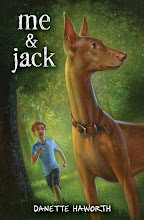
Recently, a group of Pharaoh Hound owners invited me to join their group. I did, and now I see photos daily of one of the most elegant dogs God ever created. The dog on the cover of Me & Jack is a Pharaoh Hound. Maureen Key-Del Duca gave me permission to share this photo with a little information that gives you an idea of their personalities: From front to back: Lola, Farley, and Titus, but Maureen tells me their nicknames are Lolabelle, Farticus (for a reason!) and Titus the bite us. Aren't they beautiful?

Me & Jack Nominated for Great Stone Face Book Award!

While perusing the Internet, I discovered a wonderful surprise: Me & Jack has been nominated by the Children's Librarians of New Hampshire for the Great Stone Face Book Award 2012-2013! This is such great news! I've read some of the other books in the list and I'm thrilled to be in the same company as Brian Selznik, Cal Ripken, Jr., Lauren Oliver and other great authors. Now I know what actors mean when they say, "It's an honor just to be nominated."

Thank you, New Hampshire Librarians!

Twinkle, Twinkle, Me and Jack


Twinkle, Twinkle, Me and Jack
                                                             
Twinkle, twinkle, Me and Jack,
Dog on the cover, paw print on the back.
Some schools have it on reading lists,
The book has adventures and turns and twists.
Twinkle, twinkle, Me and Jack,
Dog on the cover, paw print on the back.

Bookstores ask me to come and talk,
On their shelves my books are stocked.
I will come and sign them then;
I will bring a fancy pen.
Twinkle, twinkle, Me and Jack,
Dog on the cover, paw print on the back.

If you buy one, it'd be so cool.
You could show your friends at school.
A boy, a dog, and trouble await--
I hope you think this book is great.
Twinkle, twinkle, Me and Jack,
Dog on the cover, paw print on the back.

The dog is noble; the boy is brave.
There's a bully in it, too. He misbehaves.
You might laugh and maybe you'll cry;
Maybe when you're done, you'll have red eyes.

Twinkle, twinkle, Me and Jack,  
Dog on the cover, paw print on the back.         

Dylan and Cole Sprouse!

Now they're good looking guys with deep voices, but look how cute and funny they were at six years old with Jay Leno!

An Ode to My Pain

Carpal tunnel
go away.
Rotator cuff
some other day.

Leave me now,
give me rest.
I've books to write.
All my best.

Violet Raines has won CYRM!

More than 300,000 students in California voted on their favorite books, and Violet Raines Almost Got Struck by Lightning won the California Young Reader Medal for the Intermediate category! I am thrilled and honored to announce this news--Violet Raines was my first book, and to have readers think so well of it is nothing short of wonderful.

Thank you, California Young Readers!

Can You Diagram this Sentence?

Years ago, I was editing a piece and could not for the life of me decide upon the proper grammar for a certain phrase, a colloquialism I've seen written two ways. I thought if I could diagram the sentence, I would then know how to edit it, but even with the help of The Little, Brown Handbook and CMS, I couldn't figure it out.

I ended up on the phone with a Writer's Digest editor trying to determine the proper wording for this sentence:

I better be going  OR

I'd better be going.

The editor was nice and offered a lot of advice, but she was not able to diagram the sentence, either, and asked me why I needed to. I explained my endeavor to her.

"You can't diagram that phrase," she said. "It's a colloquialism." She advised thusly: Use I better be going for informal prose, and I'd better be going for more formal prose.

I've followed her advice ever since, but it seems to me as if there's somehow an object in that phrase. It niggles at me. I better be going. Is this phrase actually shorthand, a phrase that represents a grammatically correct sentence from the old days, something like this: It is better for me to leave than to stay.

Better has to have a reason for being there. What do you think? Can you diagram this sentence?

Secret Stuff I Can't Tell You and Some Other Stuff I Can!

Okay, folks, I found secret good news on the Internet, but I need to wait until I hear it officially, otherwise, I can't tell if I'm reading properly or just dreaming. I'm not sure, but I think something good has happened for this girl:


Stuff I can tell you: The ARCs for A WHOLE LOT OF LUCKY came in yesterday! Here are the front and back covers:
YAY!

Come Downtown O-Town for POETRY SLAM Saturday!

Come to the cool downtown branch of the Orange County Public Library tomorrow at four to enjoy lattes, cheesecake, and the National Poetry Month Slam competition! I'm attending as a spectator, and I'm looking forward to it. Say hi if you're there--I'll be clothed in traditional literary black.


See you there!

My New Book has a Cover!

Here's the cover for A Whole Lot of Lucky, coming out September of this year!

Orny Adams at The Improv Orlando

Orny Adams, you were wonderful!

Shot in the Arm for Writers and Goodbye

Hello writers!

Pumping myself up this morning and thought I'd share some words I found encouraging: I watched a video in which Joyce Carol Oates said the first six weeks of a manuscript are hell. Writers, we are not alone! Also, last year I went to an excellent seminar conducted by Candace Havens. She talked about fast drafting and writer's block, summing it all up with this: "When you're stuck, keep writing, even if it makes no sense." I can do that! I will do that!

And goodbye, for a few weeks, anyway. I've got to buckle down and write, so I'm dropping out for a while. Have a great day, and I'll see you later!

Two Flavors of Lucky is Now Called . . .

Two Flavors of Lucky is now called . . . A WHOLE LOT OF LUCKY! Look for it September 2012!

Chasing Squirrels is Hard Work


Casey takes a quick break after freeing her territory--temporarily, anyway--of those cheeky squirrels who blatantly climb the oak and leap onto the bird feeder when she is trapped behind sliding glass doors.

Lizard Seeks Role in The Summer of Moonlight Secrets

So this lizard pops in through the screen, runs up the table scrambling right for me, and I'm all screaming and "AAAH THERE'S A LIZARD IN THE HOUSE!" but he waves his hands to shush me and says, "Are you the author of The Summer of Moonlight Secrets?"

I can't shut my mouth because, you know, this lizard has just spoken and he does not have an Australian accent. "Whatdja say?" I ask. I heard him; I'm just fudging for a few seconds to cover my disappointment.

His little hands looks like mine, if mine were green and lizardy. He folds them and shrugs his shoulders. "I hear there's a lizard in your book."

I nod. "Yeah, a few of them."

"I've come to audition for the part. I could play all of the lizards, actually--no one would know." Desperation glints from his bulbous eyes.

"It's not a movie." Yet, I secretly think. "It's a book. You can get get in hard cover, paperback, bookfairs, ebooks--"

He shakes his flourescent head. "I need a job."

"Have you tried insurance companies?"

He sneers. "Yeah, that guy. Do you know he's originally from Key West?"

"No!" I pound the table with my fist. "I knew that accent was fake! How'd he get to Hollywood?"

My new friend rolls his eyes. "He knew a guy who knew a guy--you know how it works."

He jumps off the table, squiggles across the floor, and just before he exits through the hole, he turns his head over his shoulder and says, "Well, keep me in mind, will you?"

"Wait!" I rise. "Can you do an English accent or maybe Irish?"

He smiles--at least that's what I think his mouth does--and he mimes tipping a hat. "Top o'the mornin' to ya, luv."

I clap with glee. "Bring me a headshot," I say. "I'll see what I can do."

A Plea to My Husband from our Garage (with apologies to those who read this last year, but the garage suffers untouched)

O Master of the house,

I am blighted and ashamed. Lift your hand to me, and I will be restored. Once, I stood, open and ready before you. Now my contents spill over like vomit from a drunk. Your neighbors to the south snicker as they pass; your own children hold their noses against my stench. In shame, they lift their scooters and roll out through the house. In shame, they enter only through the front door. In shame, my mouth remains shut.

But you, my master, have the power to lift this ruin from me. Remember when I was new, when you saw that I was good and housed your car and not trash in my belly. Do this for me this weekend, master, that I may lift my door and show my glory to your neighbors. He is good, they will say. We were mistaken. Your children will access my innermost parts and the feet of your bride will alight upon my floor once more.

And for you, I will house you in comfort and organization forevermore.

Horn Book and Linworth Publishing review Me & Jack

Linworth Publishing Company Reviews
Library Media Connection Reviews 2011 August/September
Josh Reed is from a single-parent home where moving is a way of life since his widowed dad is in the [air force]. The Vietnam War is being fought as he and his dad adjust to life in their latest home. They adopt a stray dog, Jack, [who] proves to be both a trial and a blessing. . . . This is a refreshing read that accurately portrays "life back home" during a tough time in our country's cultural history. Douglas K. Dillon, Ph.D., Library/Media Specialist, Lakota Plains and Lakota Ridge Junior Schools, West Chester, Ohio. RECOMMENDED ¬ 2011 Linworth Publishing, Inc.


Horn Book Guide Reviews 2011 Fall
Father and son, and their dog, Jack, are greeted with suspicion in their new town, especially after one soldier comes home and another is killed. The story touches on bullying, violence, war, friendship, and trust. Though there are some plot contrivances, the complex characters are well defined. Copyright 2011 Horn Book Guide Reviews.

The Author Writes Outside

After dropping children off to school, the author drove over back roads to get home. No clouds in the powder blue sky, the sun streamed fully, enough to warm the misnomer of Florida winter. It's so pretty outside, the author thought. She'd rolled the windows down, and her little dog stretched her neck to smell everything they passed. Other people walked by with their dogs, and others jogged in bright exercise clothing, wires coming out of their ears. The dog's tail wagged against the owner's arm at all the activity.

She would work outside today. The sun, the people, the morning's energy--all of it heightened the promise of the day, that she could accomplish everything she wanted to.

She left the dog at home and returned to the park with her laptop. Aah, the author's heart murmured. This was what she needed. She couldn't stand to be trapped indoors, her thoughts and imagination limited by the four walls she was boxed in. So much better to be outside.

She tilted the monitor several times to find an angle in which the sun didn't glare. But it was a bright day; a minor glare wasn't so bad. The author put her sunglasses on, but now she couldn't read her own words on the screen. Fishing in her purse, she pulled out her reading glasses and put them on under the sunglasses. (She did not want to look like an old lady.) Even so, the two pairs of glasses proved cumbersome. They didn't line up properly because the stems were too bulky to sit together on her ears. She found herself looking up whenever a car passed. Many of her neighbors took this route, and she couldn't prevent the reflexive action of checking the vehicles to see if she should wave or not. The bench had an odd slant that caused the laptop to slide down her legs.

This was impossible.

She closed up her laptop, removed the reading glasses, and walked to a nearby coffee shop with outdoor tables. This is where she should have come in the first place. Look there--two girls, college-age probably, huddled around a bistro table, one searching through a book, the other clacking on her keyboard. The author smiled. Now she was in her element.

She began to write. A bizarre tune struck the air, and a man at the table next to hers answered his cell phone. He spoke loudly, and the intrusion of his voice scrambled the author's brain. She accidentally typed the words he spoke. She shot him a look. She sighed loudly. She moved about in her chair as though she couldn't possibly get comfortable. The man kept talking. Sandhill cranes gobbled overhead, then landed on the sidewalk, strolling in that slow moving way they had. They weren't afraid of anything. They would hold up whole lines of traffic crossing the street, the same way sheep did in Ireland. Now the college girls burst into laughter.

Too many distractions, the author thought. Plus, she needed her desk at home where she could spread out her ideas like peanut butter on bread. She would fire up a cappuccino and start afresh.

When she got home, she set herself up in her office, skipped the cappuccino, and dropped into her chair. The sun teased her, dappling the window and reaching right through the glass to touch her face.

Rebecca Black, Demetri Martin, and The King of Empty Promises from Kids in the Hall

I cannot say, "It's Friday," without hearing Rebecca Black; I cannot look at Demetri Martin's book, "This is a Book," without hearing his monotone little tune; and I can NEVER say "Will do" without thinking of "The King of Empty Promises" from Kids in the Hall:

It's Not Too Early for Bruce, Is It?

Never too early for Bruce!

Yes, Virginia, It Does Snow in Florida

Contrary to what mainlanders might believe, snow does fall in the Sunshine State. We saw "legitimate flurries" in January 2010, a "dusting" in November 2006, and a "light covering" in 1982.

And soon, we will see snow in this park, just past those palm trees.

Strange Words and Quirky Titles

Facsicle, today's word--courtesy of Dictionary dot com--is a strange word. It sound like facsimile. What kind of -sicle is a fac? I know what fudgesicles are and popsicles, so facsicle must be a fac on a stick and something enjoyed on a hot day.

Ah, but it is not, no matter how reasonable my definition above sounds.

Here's a clue: Harry Potter is a facsicle. So is Junie B Jones.

The definition as provided by Dcom: "A section of a book or set of books published in installments as separate pamphlets or volumes."

Work this in to your conversations to sound intelligent or pompous (the effect depends on whom you're talking to). A better use: lay it down in Scrabble. Your opponents will challenge you and lose their turn, HAhahahahaha!

Strange new words lead us now to quirky titles, of which I am a big fan. My first book's title is Violet Raines Almost Got Struck by Lightning. I love this title because it lets the browser know, Hey, something exciting happens in this book! This is no sit-around-girl--she almost gets struck by lightning!

Also, maybe Violet is exaggerating. Maybe she stretches the truth--is that what the title is telling us? And maybe there's a little humor, because that's not something you hear in everyday conversation.

I am thinking about titles because we're still working on a new title for my upcoming book, TWO FLAVORS OF LUCKY. My editor and I and others at Bloomsbury/Walker have been brainstorming, but have yet to strike upon the right replacement. Myself, I'm a fan of longer titles--they tend to be quirky and humorous. So it's fortuitous that the latest edition of the SCBWI mag contains an article by Hazel Edwards entitled "Speed Dating: How to Make Up Titles for Stories." I plan to use her advice today after I finish my copy edits.

But first, I need another cappuccino and perhaps a blueberry muffin (seeing that I am out of donuts).

Have a great day!

NaNoWriMo--Tips for the Young Writers (and anyone else)

A HUGE number of young writers are participating in NaNoWriMo. How do I know this? One of them lives in my house. Not to brag, but she is a really good writer. Her name is going to look so good on book covers.

So, I want to tell you other young writers the same things I told my own daughter in case your mom or dad isn't a writer:

First off, I'm proud of you for undertaking this goal. You must be serious about writing, or you wouldn't have signed up, you wouldn't have told people, and you certainly wouldn't have broadcasted it on Facebook.

Okay, I know you just want to write. You're eager to get started--the idea's already in your mind--so why bother with the preliminaries, right? Wrong. (You knew I would say this.) Even though today is November 7th, please consider this advice: Your writing needs structure. You need to build the skeleton first. Writing without an outline is like driving without a GPS (or map for you old folks, heh heh). Knowing your destination is not enough--you need to know how to get there. An outline ensures that you CAN get there, and it prevents you from taking scenic detours. An outline proves that your story can be executed.

What do you need first? Well, for some people, plot comes first ("I want to write about a monkey winning the next presidential election.") Sometimes, voice comes first. This was the case for me when I wrote Violet Raines Almost Got Struck by Lightning. I was sitting at my computer thinking--and don't be afraid to "waste" time thinking. You must allow the writer inside to explore the literary playground--I probably thought for about two weeks. (I did eat, sleep, and do those other human things necessary for living.) Anyway, one morning, I turned in my chair and I swear I could see her, a wiry tan girl, with dark hair blunt cut at her shoulders. The cypress trees and the river were behind her, and so were her friends. "When Eddie B. dared me to walk the net bridge where we'd seen an alligator and another kid got bit by a coral snake, I wasn't scared--I just didn't feel like doing it right then." That's what she said. She said a few more things and I typed them up real fast and those exact words became the first paragraph of my first book.

So, if you have plot, you need to come up with voice. If you've got voice, you must come up with a plot. For the rest of this discussion, let's call our main character Jimmy.

What is a plot? Beginning, middle, and end. Not that simple. Jimmy has to have a goal, something he can't live without--this can be simplified into changing the situation or struggling to keep it the same. He must encounter obstacles, obstacles that increase in difficulty. The obstacles must be part of the story; don't throw things in and never mention them again. There's a saying for writers: If you mention a gun in the first act, you'd better fire it by the third.

The best obstacles are other people. Their motivations can either be because they love the main character. ("Jimmy, I can't let you skateboard off Dead Boy Cliff.") or because they hate the main character ("I'm going to jump Dead Boy Cliff and show everyone I'm better than Jimmy.") Or maybe they have the same goal, they're equally as good (or bad), and their efforts, working in tandem with your main character's, make things harder. ("Sorry, Jimmy--Connor Brown just bought the last Lightning Strike Skateboard, the best skateboard in the world.") Start off with small obstacles and increase them until you reach the climax, which shouldn't happen until 3/4 of the book has passed, or 4/5 or 5/6 or you get what I mean--very close to the end.

In Jimmy's case, his goal and obstacles could look like this: His goal could be to win the Dead Boy Cliff Jump, because winning would give him the money he needs to hire a lawyer for his dad who was framed for a crime he didn't commit (wow, did you see that--we just slipped a sublayer into our story!) Obstacles: his skateboard can't handle the cliff. When his best friend offers his skateboard, they find it mysteriously broken. Jimmy's too young for a real job, and plus he needs a lot of money, fast. He starts mowing lawns, babysitting, dog-walking, but the money is too slow.

Dad's former partner, Nick, a young college dropout, sees Jimmy's determination and becomes a friend, asking Jimmy how things are going and really listening. Both Jimmy and Nick get really sick after eating at a local diner. Jimmy ends up in the emergency room, Nick by his side. After a few days in the hospital, the doctor says Jimmy is good as new and can perform the jump as planned. Mom forbids Jimmy to jump. They have a heated argument. Frustrated, Jimmy turns to Nick, who offers to lie to Mom about Jimmy's whereabouts so Jimmy can train. One day, Nick is carrying the gear, but says he forgot his cell and goes back to the car. When he returns, Jimmy gets the skateboard from him. It's his first run down Three Mile Hill and he's doing it, he's sailing! But a wheel falls off and Jimmy catapults over the board. His ankle's sprained . . . so like that, you keep increasing the obstacles.

Just so you know the end of this story, Jimmy doesn't make it to the jump--instead he wrestles against ropes and a locked door, having been kidnapped by Nick after discovering that Nick framed his father. The climax is Jimmy's dramatic struggle to get free and the denouement is having his father at home, the scene is after supper and Dad walks him out to the garage, where a brand new Lightning Strike skateboard awaits him.

Back to other nitty gritty details about NaNoWriMo and young writers. You must set a reasonable goal. Think about your school schedule, your homework load, your scheduled activities, and your responsibilities at home. Can you realistically write 1666 words a day, seven days a week? Think about it. Do not set yourself up for failure. I heard Linda Sue Park speak at a conference and she said her daily quota was two typed pages. This is a professional, well-respected author.

What daily quota will work for you? Will you work on weekends? Are there days that you can't work? Think about it and make a schedule. Oh, that sounds horrible, doesn't it? A schedule, blech. Well, writing is a job that you need to show up for. If you set up a schedule, you will be primed to write at that time because all day long, you know that writing session is in front of you. Ideas will tickle your brain, dialogue will move your lips, your fingers will itch for that keyboard. Set up a schedule and commit to it.

If you can do 50,000 words in one month, more power to you. But for the rest of us, viewing NaNoWriMo as a starting point is great idea. When I write, I want to succeed. Some days I feel I am reaching into a fog pulling words from a murky lake; other days I'm on fire and can hardly type fast enough to keep up with my brain. I can't tell you my daily goal because I feel I'll somehow jinx myself, but I will tell you my goal is both realistic and challenging and I don't leave my keyboard until I've met it.

Good luck, young writers. I believe in you.

A Note to Peyton M.

Hi Peyton,

I hope you don't mind me posting this response, but your email address keeps bouncing. I sure hope you get this.

Anyway, thanks for emailing me and telling me how much you enjoyed Violet Raines. Your email made me feel good about writing.

I enjoyed Violet Raines, too, and that is my biggest tip to you--write something you enjoy. Create a character you want to spend time with and let her have real feelings. You know the secret feelings you have--embarrassment, feeling left out, liking someone--your character has those feelings, too, and so do most people. Make her as real as you are and your book will come alive.

Good luck on your writing, and have a great day!
Danette